

Growth to buyout, garage to global. Vol. I, No. 2
Friends,
It’s Wednesday and another edition of The Growth Docket. What does “growth equity” mean for me: it’s where venture capital meets private equity.
The Federal Reserve raised interest rates last week for the first time since 2023, and the cost of borrowing for a buyout had already gone up before that. This week: what a room of executives and investors concluded about buying, selling or waiting; a $600 million healthcare deal that is mostly a payout to existing shareholders; a CEO buying his own public company; and who can still borrow to make an acquisition. There is also a new section for general counsel who have changed jobs.
Monday in Palo Alto: Buy, Sell or Wait
Thank you to the executives and investors who filled the Silicon Valley office on Monday, and to Jason Babcoke of Sumeru, Rob Bartlett of Jefferies, Harish Belur of Riverwood and Gargi Ray of Synopsys for the panel.
The invitation asked whether a company should buy, sell or wait. The panel’s view was that waiting is not really an option, because a company is never standing still.
The point that stayed with the room was this. Most executives think a sale process begins when the board hires a banker. It does not. From the day a company takes outside money, buyers are watching it. Every quarter’s results, every customer that renews or leaves, every senior hire and departure is information someone is collecting. The only question is whether management is in charge of that evaluation or on the receiving end of it.
So the advice for a CFO is simple. Keep the data room current when there is no deal. Know your customer retention numbers before a buyer asks. Talk to your board about the 2021 preferred stock before an investor forces it. Being ready is not the same as wanting to sell. It is what lets a company say no with credibility, and say yes on its own terms.
A fuller recap of the takeaways follows next week.
The Growth Tape
Technology. Priority Technology, a payments company, agreed on Monday to be bought by its own chairman and CEO, Thomas Priore, with money from Searchlight Capital, at $8.05 a share: a 65 percent premium and about 30 percent more than his first offer last November. When a CEO buys the company he runs, the independent directors have to negotiate against their own boss, and the rising price suggests they did. In Delaware a deal like this needs approval from both an independent committee and a majority of the shareholders outside the buying group. Expect more while stocks are cheap and executives have backers.
Healthcare. Vitruvian Partners led a $600 million investment in Angle Health, a health insurer, at a $2.7 billion valuation. Only $200 million is new money for the company. The other $400 million buys shares from existing holders, a tender offer. That is what a growth equity deal looks like this year: one check that funds the business and lets founders and early investors take some money off the table. Two terms decide whether a tender goes well: who is allowed to sell, and in what order, and what the sellers promise. The company should stand behind the its statements; the people selling shares should not have to. Also, MRO bought Vyne Medical from TJC, one private equity firm selling to another, in a quarter when those deals fell by half.
Life sciences. Four investors combined Kincell Bio and Cellipont into one company that manufactures cell therapies for drug developers. With biotech companies unable to go public, investors are buying the businesses that make the medicines instead. The legal work is mostly regulatory.
Clean energy and data centers. The backlog of financings is starting to move, with as much as $80 billion of data center debt in the queue. Lenders want a long lease with a large tenant like Microsoft or Amazon and a confirmed connection to the power grid. Projects with both get financed first.
The Loan Desk
The Fed raised its target range to 3.75 to 4.00 percent. Sixteen of the eighteen officials expect another increase this year, and the Fed’s projections show no cuts through 2027.
A buyout feels that right away, because the loan usually carries a floating rate. A growth equity deal usually has no debt, so nothing changes on the way in. What changes is the exit: whoever buys the company in a few years will borrow at that day’s rate, and will pay less for the company because the loan costs more.
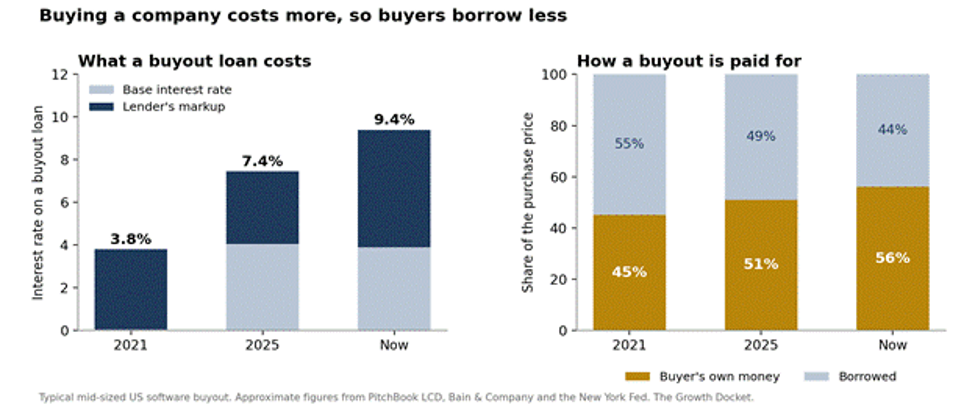
On the left, the interest rate on a loan to buy a mid-sized software company: about 3.8 percent in 2021, about 9.4 percent today. Both parts went up. The base rate, which follows the Fed, went from near zero to about 4 percent, and the markup lenders add on top rose after software stocks fell in the first quarter and has not come back down. On the right, how a buyout is paid for: in 2021 a buyer put in about 45 percent of the price and borrowed the rest; now the buyer puts in about 56 percent. Less borrowing means buyers can pay less for companies.
Is there trouble in the loans already out there? Some, and it is mostly hidden. Moody’s counts the true rate of trouble on loans held by investment funds at 4.7 percent, against a reported 1.6 percent. The gap is loans that have been extended or rewritten rather than declared in default. About one loan in ten now lets the borrower add unpaid interest to the balance instead of paying cash, up from one in sixteen in 2022. New loans are different: lenders are putting the financial tests back in.
Can a company still borrow to make an acquisition? It depends on the company. The pipeline of buyout financings is the largest since 2007, but most of it is going to companies adding a smaller acquisition to an existing loan, or refinancing. A new loan for a software company that charges per user is hard to get at any price, because lenders cannot predict its revenue once customers use AI to do the work. A company with steady customer retention in a regulated market can borrow this month.
Funds and People
🔹 Morgan Stanley raised $1.3 billion for its first growth equity fund. The bank that advises a company on its funding rounds, its IPO and its sale will now also invest in it. A conflicts question for the documents, and an edge in finding deals.
🔹 CVC raised $10 billion for its sixth secondaries fund, nearly twice the last one. Secondaries funds buy stakes from investors who want their money back before a fund sells its companies. Record amounts, because a lot of investors want out.
🔹 Too much money, too few good companies. In BDO’s survey of 400 US private equity managers, 82 percent expect prices to rise because there is more money to invest than quality companies to buy.
🔹 Bay Area. New fund, new office, new partner? Send it here.
High Fives
The general counsel’s job changes hands quietly, and it should not. From the last month:
Elena Leichty was promoted to GC at Anthropic ahead of what may be the largest public offering ever, with Jeffrey Bleich handing her the seat. Jeff Held is the new Chief Legal Officer at MBX Biosciences, from Deciphera, where he helped sell the company to Ono Pharmaceutical for $2.4 billion. Jeff Boerneke is GC at Aspen Neuroscience, from Gossamer Bio. Jamie Haney is now Executive Vice President and GC of Sanofi. Michael Parini is Chief Legal Officer at Biogen. Steve Chen is GC at OncoC4. And Nancy Denyes is stepping down as GC of aTyr Pharma on September 30 and staying on as a consultant through its late-stage trial.
Moved, promoted or stepped back? Send a note and it will run here.
In the Courts
🔹 Priority Technology is the first sizable deal of its kind since the Delaware Supreme Court upheld the state’s new rules for controlling-shareholder deals in Rutledge v. Clearway. The lesson from KnowBe4 in May still applies: every claim against that board over Vista’s $4.6 billion purchase was thrown out because the independent committee had real authority and outside shareholders voted with full information. Courts ask for a process the board can explain, not a perfect one.
🔹 Anderson v. Intel is argued at the Supreme Court on October 6: what an employee must show to sue over private investments in a 401(k) plan. The answer decides how much litigation risk stands between private equity and retirement money.
From My Desk
🔹 Private Equity’s $285 Billion Shock Year Still Has Real Openings, new on Foley Ignite: the year so far and the seven legal changes that matter most.
🔹 Where We Are on Software M&A, with data from Rob Bartlett and Jefferies.
🔹 Coming next: what a CEO and GC should do in the first days after an unexpected approach from a buyer.
On the Calendar
🗓 Hard Things, Monday, September 28, Foley Silicon Valley. Robotics and physical AI, with Chris Yeh. Request an invitation.
🗓 Ready for Anything: IPOs, SPACs and Capital Market Shifts, Tuesday, October 6, Foley San Francisco, with Open Future Forum. Register.
🗓 LP/GP Event with Jersey Finance, Monday, October 12, Foley San Francisco. Reply for a seat.
🗓 Investors on the Bay, a Fall Mixer, Friday, October 23, San Francisco. Register.
🗓 One Way Ventures Summit, Wednesday, October 28, San Francisco. Register.
🗓 General Counsel Executive Forum, Private Lunch, Friday, October 30, San Francisco. In-house counsel only. Request a seat.
🗓 IPO Readiness, Wednesday, November 18, San Francisco, with SVB, Protiviti and Heffernan. Reply for a seat.
🗓 2027 Outlook, Friday, December 11. The full group and the year-end scoreboard. Reply for a seat.
Closing Argument
🔹 Founders, CEOs, CFOs, GCs, CXOs: buyers are evaluating your company whether or not you have decided to sell. Keep the data room current and the retention numbers ready, and the decision stays yours.
🔹 Directors of smaller public companies: management buyouts are back. Form the independent committee early and give it real authority.
🔹 Companies that need to borrow: lenders are lining up for some borrowers and avoiding others. Know which one you are before you start.
Rates moved a quarter point. The deals that close this fall will be the ones built